You did everything right. You skipped the trips, packed lunch, watched the balance in your savings account climb. And a few years in, you looked at that number and felt something you didn’t expect: disappointment. All that discipline, and the number barely moved on its own.
Here’s the uncomfortable part — it never will. A savings account is a holding pen, not a growth engine. The debate around saving money vs investing isn’t really a debate at all: saving protects money, investing multiplies it, and confusing the two is the single most expensive mistake most people make in their twenties and thirties.
This post breaks down exactly why saving isn’t enough, what investing and asset building actually mean in plain language, and a simple framework you can start with — even if you’ve only got $50 a month.
📥 Free download: The Wealth Building Starter Guide
The exact order to save, invest, and build assets — the four-stage framework in one printable PDF. Drop your email below and it’s yours.
As an Amazon Associate, I earn from qualifying purchases. This post contains affiliate links — if you buy through them, I may earn a commission at no extra cost to you. I only recommend tools I actually use.
Why Saving Feels So Safe (And Why That’s the Trap)
Saving feels good for a reason. The number only goes up. There’s no red day, no market crash, no headline that makes your balance drop 20% overnight. Every deposit is a small win you can see.
That feeling is real, and it’s also the trap. Your brain treats “no visible losses” as “no risk.” But a savings account carries a risk you can’t see on the statement: purchasing power risk. The number stays the same while what that number can buy quietly shrinks.
We were also raised on it. Most of us got “save your money” as childhood advice, usually from people who never got “invest your money” as theirs. Saving is the financial advice of people who were taught to avoid losing — not taught how to win. That’s not a criticism of parents or grandparents; it’s a recognition that they passed down the playbook they had.
The result: saving becomes an identity (“I’m good with money”) instead of what it actually is — step one of a longer process. And when step one feels like the whole game, most people stop there.
The Limitation of Saving: Inflation Is a Silent Tax
Here’s the math nobody shows you when you open a savings account.
Say inflation runs around 3% a year — roughly its long-term tendency. At that rate, $10,000 sitting in cash today buys only about $7,400 worth of stuff in ten years. In about 24 years, its purchasing power is cut in half. You didn’t spend a dollar. You still lost.
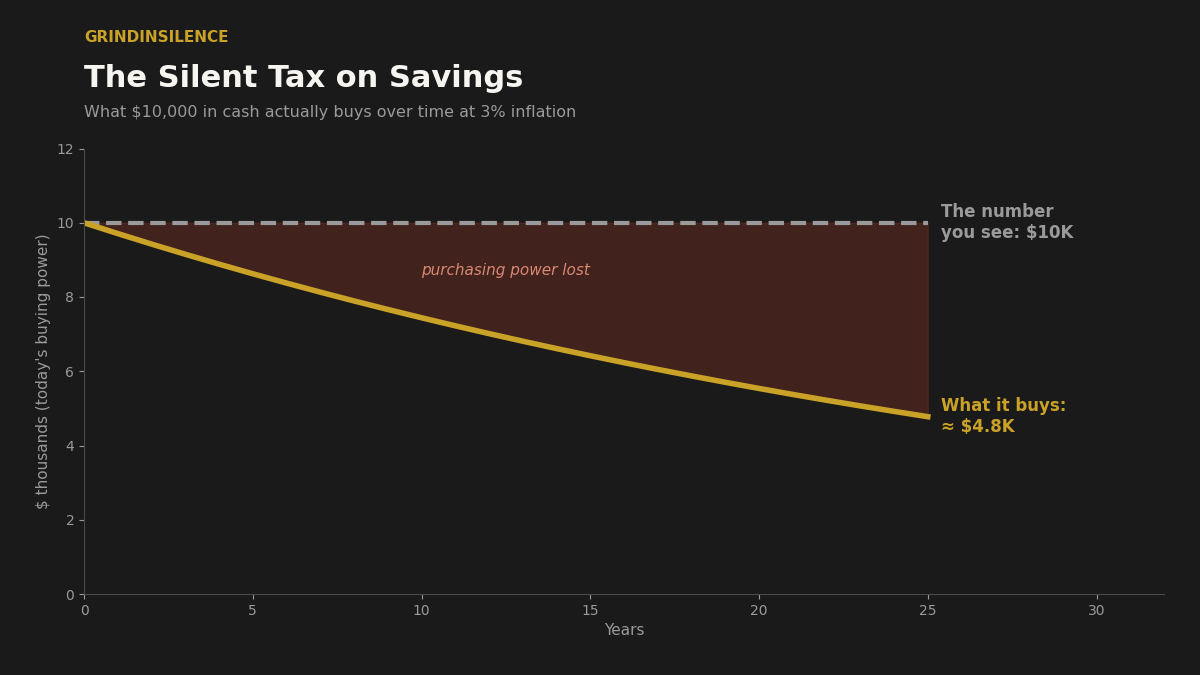
“But my savings account pays interest.” Sure — and for most of the last two decades, standard savings accounts have paid well below inflation. Even a decent high-yield account roughly treads water against inflation in a good year. Treading water is the best case. That’s the ceiling on saving: at its absolute best, it preserves what you have. It cannot multiply it.
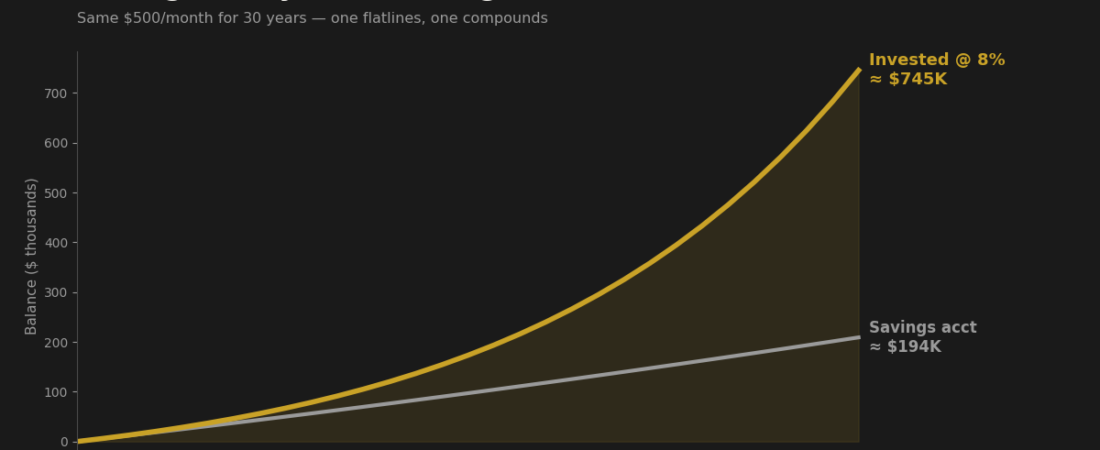
Now run the comparison that actually matters — $500/month for 30 years:
| Where it sits | Assumed annual return | Ending balance |
|---|---|---|
| Standard savings account | 0.5% | ~$194,000 |
| Invested (broad index funds) | 8% | ~$745,000 |
Same discipline. Same $180,000 of total contributions. Roughly $550,000 difference — and that’s before you account for the fact that the savings-account version lost purchasing power the whole way. (The 8% figure is an illustration, not a promise: the S&P 500 has averaged about 10% annually since 1957 — roughly 6–7% after inflation. If you’re new to how that growth works, start with my plain-English guide to compound interest.)
This is why saving isn’t enough. It’s not that saving is bad. It’s that saving alone puts a hard cap on your outcome, and that cap is “slightly less than what you put in, adjusted for inflation.”
The Wealth Gap: Savers Earn Wages, Investors Own Assets
Zoom out and you’ll notice something about how wealth actually distributes. The gap between the middle class and the wealthy isn’t primarily an income gap — plenty of high earners are broke — it’s an ownership gap.
Wealthy households hold most of their net worth in assets: businesses, stocks, real estate, intellectual property. Middle-class households hold most of theirs in a primary home and cash. One group owns things that generate money and appreciate. The other owns a place to live and a pile of slowly-shrinking dollars.
That’s the wealth gap in one sentence: savers trade time for money and store it; investors convert money into things that earn without their time.
And here’s the part that should actually make you optimistic: the barrier to switching sides has never been lower. Your grandparents needed a broker, high fees, and serious minimums to own stocks. You need a phone and $10. The gap persists mostly because the knowledge hasn’t spread — which is exactly what the rest of this post is for. (Once you’ve got the basics down, how passive income actually works is the natural next read.)
Investing Explained Simply (No Jargon Version)
Strip away the noise and investing is one idea: using money to buy things that produce more money.
When you buy a share of stock, you own a small slice of a real business — its profits, its growth. When you buy an index fund, you own a tiny slice of hundreds of businesses at once. That’s it. You’re not “playing the market.” You’re buying ownership in the productive economy and letting it work while you sleep.
Three terms cover 90% of what a beginner needs:
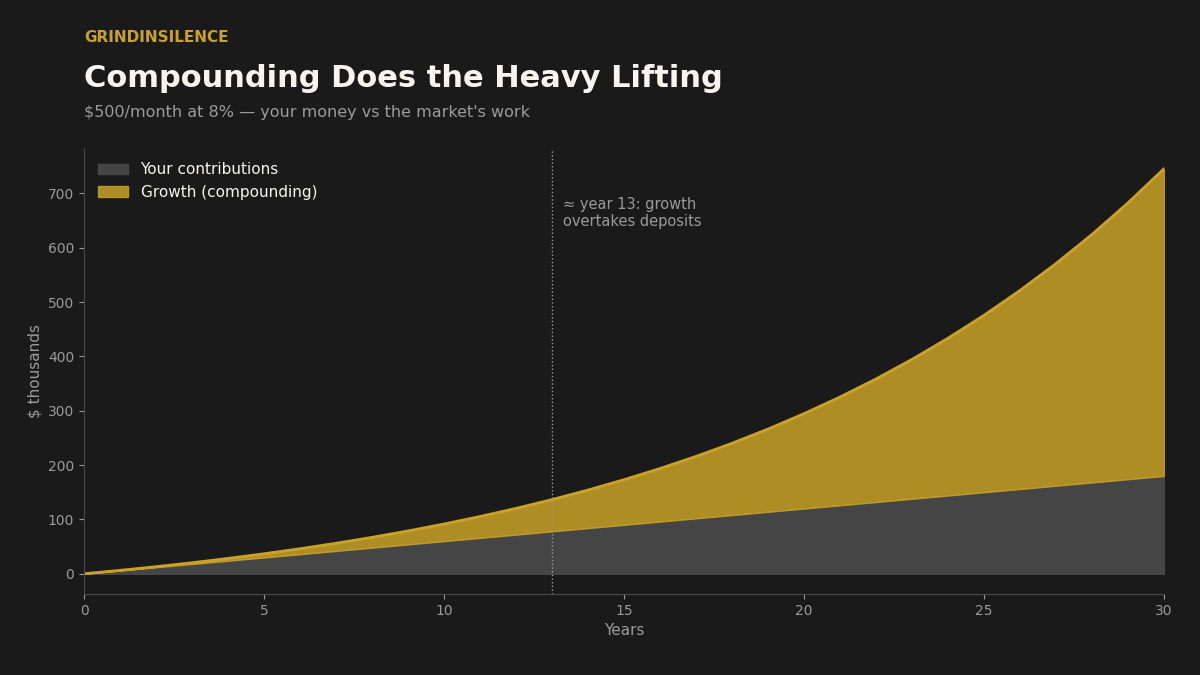
Compound growth. Your returns earn returns. Year one, $1,000 at 8% becomes $1,080. Year two, you earn 8% on $1,080, not $1,000. Stretch that over decades and the curve goes vertical — most of the growth in that $745,000 example above comes in the last ten years. This is why starting early beats starting big.
Index funds. Instead of guessing which company wins, you buy the whole market through a single fund. Low fees, no stock-picking, historically strong long-run returns. This is the vehicle most self-made investors actually use — not crypto, not day trading. (I break down the full comparison in index funds vs stocks for beginners.)
Time in the market. The data is boring and consistent: people who buy and hold outperform people who jump in and out. Volatility is the fee you pay for growth. Miss a handful of the market’s best days trying to dodge the bad ones and your returns collapse.
If you want the deepest simple explanation of this ever written, JL Collins’ The Simple Path to Wealth is the book I’d hand a beginner first — it turns everything above into a complete plan in plain English.
Asset Building Explained: The Ladder Above Investing
Investing in index funds is the foundation. Asset building is the broader skill it belongs to.
An asset is anything that puts money in your pocket without requiring your ongoing time — or that grows in value while you hold it. A liability is anything that takes money out. That framing, popularized by Robert Kiyosaki’s Rich Dad Poor Dad, is worth internalizing even if you take the rest of the book with a grain of salt (my full review here): the wealthy focus relentlessly on acquiring assets, and most people spend their raises on liabilities that look like assets — nicer car, bigger apartment.
Assets stack in rough order of accessibility:
Paper assets — index funds, dividend stocks, bonds. Lowest barrier, most passive. Start here.
Digital assets — a blog, a YouTube channel, templates, an ebook, a course. These cost more time than money, which makes them the natural second asset for anyone young and cash-poor but time-rich. Built once, they can pay for years — here’s how digital products actually make money.
Business assets — a service business, productized offers, anything with clients or customers. Higher effort, highest ceiling.
Real estate — rental property, house hacking. Real returns, but capital-heavy; this one usually comes later, funded by the earlier layers.
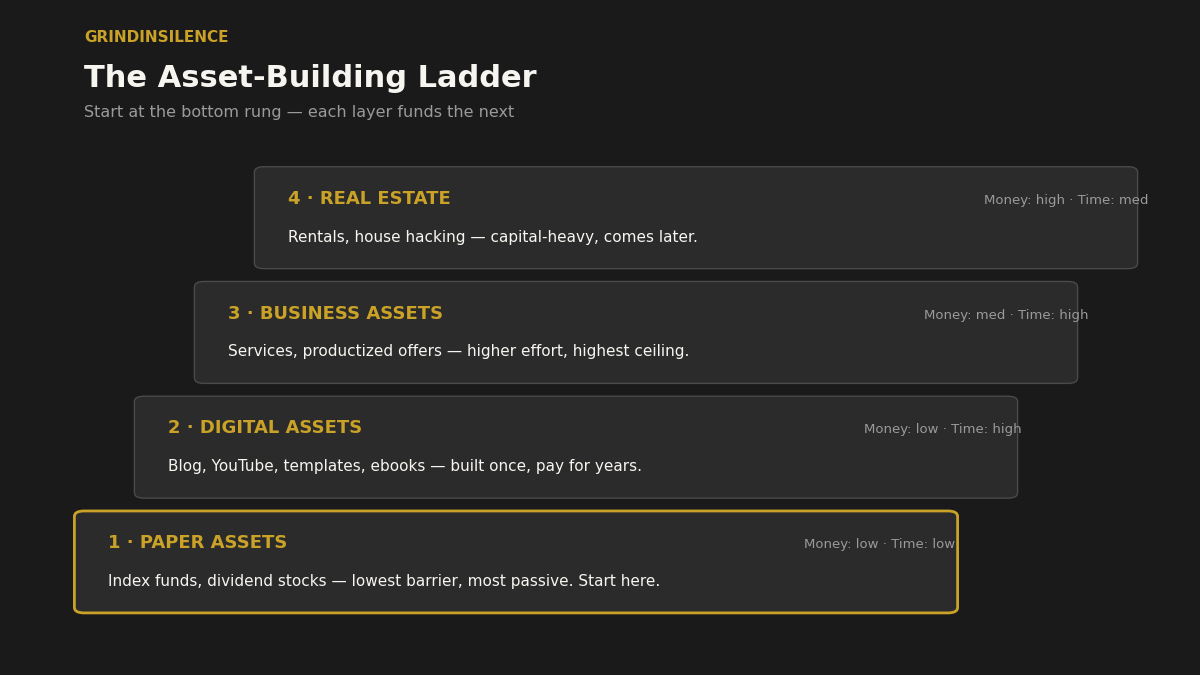
The pattern to notice: wealth creation is rarely one big asset. It’s layers — a job funds index funds, index funds compound quietly, a digital asset adds a second income stream, and the second stream buys bigger assets.
What Wealthy People Understand That Savers Don’t
Sit with genuinely wealthy people (not flashy-rich — quietly wealthy) and the same beliefs keep showing up:
Money is a tool, not a trophy. Savers accumulate money to feel safe. Wealthy people deploy money to buy assets, and the assets provide the safety. The money itself is always moving.
Behavior beats intelligence. The biggest returns come from unglamorous behavior — automatic investing, not selling in a panic, living below your means for decades. Morgan Housel’s The Psychology of Money makes this case better than any book I’ve read: financial success is a soft skill, and a janitor who invests patiently can out-build a Harvard MBA who trades emotionally. If you only read one money book this year, make it this one.
Risk means something different. Savers define risk as “my balance might go down this month.” The wealthy define risk as “I might still need a paycheck at 65.” By that definition, the savings account is the risky choice.
They buy time, not things. Every asset purchased is future hours they won’t have to work. That’s the actual goal — not a number, but optionality.
None of this requires being rich already. These are beliefs first, balances second. The balances follow.
The Wealth Building Framework: Save → Invest → Build
Here’s how the pieces fit together — the framework the free starter guide walks through step by step.
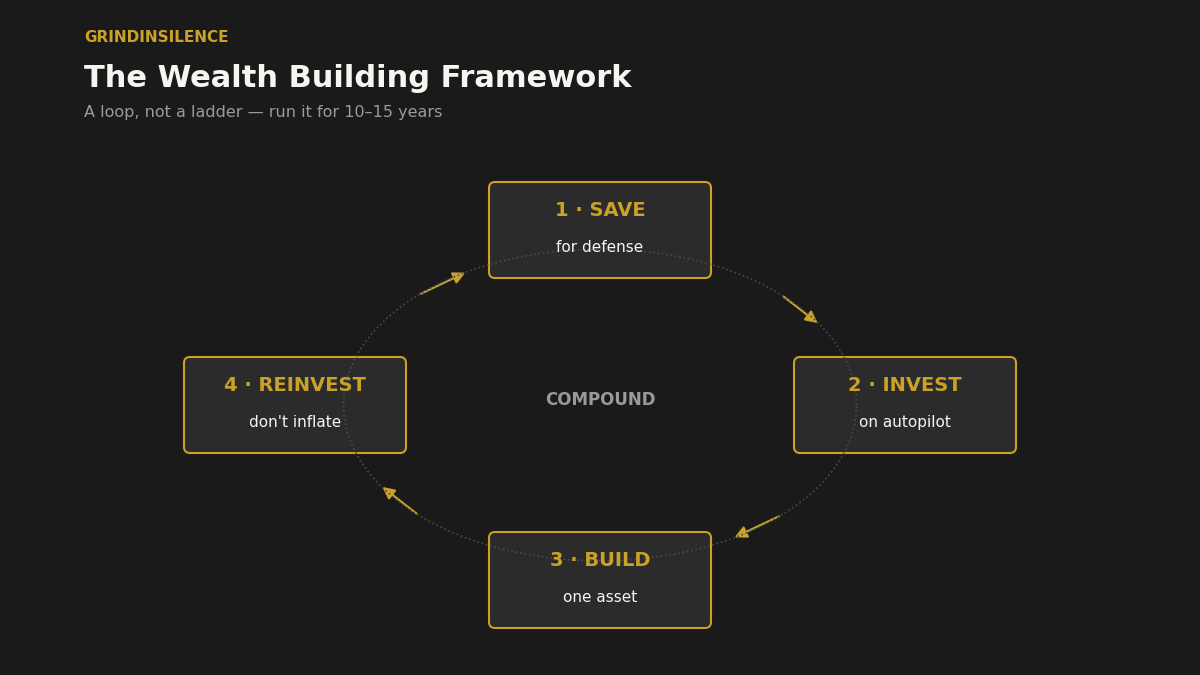
Stage 1: Save for defense (1–3 months). Build a starter emergency fund — even $1,000–$2,000 — and kill high-interest debt. This is what saving is actually for: a shock absorber so a car repair never forces you to sell investments or swipe a credit card at 25% interest. Saving has a critical job. Its job just isn’t wealth. (If you need to build that cushion fast, here’s my system for saving $10,000 in a year.)
Stage 2: Automate investing (ongoing, forever). Open a retirement account or brokerage account, pick a broad low-cost index fund, and automate a monthly transfer the day after payday. Grab any employer 401(k) match first — it’s an instant 100% return. The keyword here is automate: wealth building that depends on monthly willpower fails; wealth building that runs on autopilot doesn’t.
Stage 3: Build an asset (12+ months). Once Stages 1–2 run themselves, put your spare hours into one digital or business asset. One. The graveyard of failed wealth builders is full of people who started five things. This blog is mine; yours might be different. The point is converting time into something you own.
Stage 4: Compound and repeat. New income from Stage 3 doesn’t upgrade your lifestyle — it feeds Stages 2 and 3. This loop, run for 10–15 years, is the entire non-lottery, non-inheritance path to wealth. It’s boring. It works.
Tracking all four stages is exactly why I built my planning system the way I did — the same system inside APEX Life OS. Structure is what keeps a 15-year plan alive through ordinary weeks.
Starting With Small Amounts: The $50 Objection
“I’ll start investing when I have real money” is the most expensive sentence in personal finance.
Run the numbers on small: $100/month at 8% for 40 years is roughly $349,000 — from $48,000 of contributions. Cut it to $50/month and it’s still ~$175,000. Meanwhile, the person waiting for “real money” loses the one input they can never buy back: years of compounding. (Proof you don’t need much: how to start investing with $100.)
Small amounts also buy something the math doesn’t show — reps. Investing $50/month for a year teaches you what a 10% dip feels like, how automatic transfers work, and how to ignore financial news. When bigger money arrives later, you already have the behavior installed. The person who waited has to learn it all with high stakes.
Practical version, this week:
- Open a brokerage or Roth IRA account (most major brokerages have no minimums and no commissions on index funds).
- Set an automatic transfer for the day after payday — $50 is plenty.
- Buy a total-market or S&P 500 index fund. Turn on dividend reinvestment.
- Delete the app off your home screen. Check quarterly, not daily.
That’s it. That’s investing for beginners in four steps. Everything else is refinement.
Common Mistakes That Keep Savers Stuck
Waiting until you’re “ready.” Ready is a feeling, not a milestone, and it arrives after you start — not before.
Oversaving. Yes, it’s possible. Once your emergency fund is full, every extra dollar in savings is a dollar paying inflation tax instead of compounding. A 12-month emergency fund in cash feels responsible and costs six figures over a career.
Confusing trading with investing. Picking hot stocks, checking prices daily, chasing whatever’s mooning — that’s gambling with a spreadsheet. Investing is boring on purpose.
Cutting investing when money gets tight. Skip the subscription before you skip the transfer. The transfer is the plan; everything else is negotiable.
Lifestyle inflation. Every raise absorbed by spending resets your timeline to zero. The framework only compounds if the gap between earning and spending keeps feeding it.
Doing it all alone with no system. Motivation decays; systems don’t. Write the plan down, automate what can be automated, review monthly.
FAQ
Is saving money better than investing?
Neither is “better” — they do different jobs. Saving protects money you’ll need within 1–3 years (emergency fund, near-term goals). Investing grows money you won’t touch for 5+ years. The mistake isn’t choosing wrong; it’s using saving for a job only investing can do.
How much should I save before I start investing?
A starter emergency fund of $1,000–$2,000 (or one month of expenses) is enough to begin investing, especially if your employer offers a 401(k) match. Build toward 3–6 months of expenses in savings while investing — not before it.
Can you build wealth just by saving money?
Realistically, no. With savings interest at or below inflation, saving alone preserves purchasing power at best. Wealth creation requires assets that grow faster than inflation — investments, businesses, or income-producing property.
What’s the best investment for beginners?
For most beginners, a low-cost broad index fund (total market or S&P 500) inside a retirement or brokerage account. It requires no stock-picking, minimal fees, and historically strong long-run returns. This isn’t personalized financial advice — but it’s where the overwhelming majority of credible sources point first.
Is it worth investing with only $50 a month?
Yes — $50/month at 8% over 40 years grows to roughly $175,000, and more importantly it builds the habit and knowledge while stakes are low. Start with what you have; scale as income grows.
Your Move: Stop Storing, Start Building
Keep saving — but demote it. Saving is your defense. It was never designed to be your offense, and no amount of discipline changes what a savings account is capable of.
The move this week is small: open the account, automate the first $50, and start the clock on compounding. Ten years from now, the difference between you and the person still “saving up to invest” won’t be discipline. It will be that you understood the difference between storing money and building wealth — and acted on it.
📥 Free download: The Wealth Building Starter Guide
The four-stage framework from this post as a step-by-step PDF: exact account types, automation checklist, and your first-asset decision tree.
Build in silence. Let the compounding speak.

About Felix Guzman
Felix Guzman is a personal finance writer and the founder of Grind In Silence. He writes about money mindset, wealth building, and escaping the paycheck-to-paycheck cycle — with no fluff and no get-rich-quick promises. His mission: help everyday people build real, lasting wealth by making smarter financial decisions every day.